
10 Best Mandoline Slicers for Safe and Easy Food Prep in 2026
Discover the most efficient mandoline slicers for your kitchen. Our expert guide compares top brands, featuring essential safety tips and versatile cooking applications.
Disclaimer: As an Amazon Associate I earn from qualifying purchases from our site. Thank you for your support!

I love mandolines. They’re absolutely brilliant when used correctly, and honestly, they’ve saved me hours upon hours of tedious slicing over the years. Whether I’m meal prepping for a big family gathering or just making a quick cucumber salad on a Tuesday night, my mandoline is one of those tools I genuinely couldn’t live without.
In this guide, I’m going to walk you through the 10 best mandoline slicers available in 2026, with a heavy focus on safety features because, let’s be real, no recipe is worth a trip to the hospital. We’ll cover everything from budget-friendly options to premium picks, plus all the safety tips you need to keep your fingers exactly where they belong.
10 Best Mandoline Slicers at a Glance
| Model | Best For | Blade Types | Safety Rating | Storage Size | Check Price |
|---|---|---|---|---|---|
| Mueller Multi-Blade | Overall versatility | 5 interchangeable | ★★★★☆ | Large | Amazon |
| OXO V-Blade | Beginners | 4 styles, 21 cuts | ★★★★★ | Large | Amazon |
| Benriner Classic | Pros/precision | 1 straight + julienne | ★★★☆☆ | Compact | Amazon |
| DASH Safe Slice | Maximum safety | Multiple + chute | ★★★★★ | Medium | Amazon |
| Swissmar Borner | Premium quality | Multiple V-blades | ★★★★☆ | Large | Amazon |
| OXO Handheld | Budget/small tasks | 3 thickness settings | ★★★★☆ | Extra Compact | Amazon |
| Fullstar 6-in-1 | Value/meal prep | 6 + container | ★★★★☆ | Medium | Amazon |
| Microplane | Compact quality | V-blade + julienne | ★★★★☆ | Compact | Amazon |
| Prepworks | All-purpose | Multiple standard | ★★★★☆ | Medium | Amazon |
| Kyocera Ceramic | Small kitchens | 4 basic settings | ★★★★☆ | Extra Compact | Amazon |
What Is a Mandoline Slicer Used For?
So what exactly is this slightly terrifying kitchen tool? A mandoline slicer is basically a flat platform with an ultra-sharp blade that lets you slice fruits and vegetables into uniform, consistent pieces. Think of it as a shortcut to those gorgeous, paper-thin slices you see in fancy restaurants.
The beauty of a mandoline is in its versatility. Most models can create multiple types of cuts including straight slices, julienne strips (those matchstick-sized pieces), waffle cuts, and crinkle cuts. I use mine constantly for potato chips, gratins, coleslaw, and those beautiful shaved vegetable salads that look way harder to make than they actually are.
According to The Kitchn, mandolines have been helping cooks achieve precision since the 19th century in France. The name actually comes from the hand motion you use, which supposedly resembles playing a mandolin instrument. Pretty neat bit of kitchen history, right?
The real advantage over knife cutting is consistency. When you’re making something like potato chips or a vegetable gratin, uniform thickness matters a lot. Thicker pieces will still be raw while thinner ones burn. A mandoline takes the guesswork out and ensures everything cooks at the same rate. Plus, it’s just faster and you can slice an entire cucumber in about 30 seconds flat.
Are Mandoline Slicers Dangerous?
Let’s not sugarcoat it: yes, mandoline slicers can be dangerous if you’re careless. The blades are razor-sharp, and because you’re pushing food (and your hands) toward that blade, there’s definitely risk involved.
I’ve seen enough kitchen accidents in my teaching career to take this seriously. The most common injury is when people get into a rhythm and start moving too fast, or when they try to slice that last little bit of vegetable without using the hand guard. Your fingers are close to the blade, and it only takes one slip.
However, and this is important, mandolines don’t have to be scary. With proper safety equipment and the right technique, they’re completely manageable. Professional chefs use them every single day without incident. The difference is that they respect the tool and follow safety protocols religiously.
The reputation for being dangerous is somewhat deserved, but it’s also a bit overblown. According to safety experts, most accidents happen when users skip the safety guard or work whilst distracted. If you’re mindful and use the proper safety features, your risk drops dramatically.
Think of it like using a sharp chef’s knife. Sure, it can cut you, but with proper respect and technique, it’s an invaluable tool. The same principle applies to mandolines.
How Do You Use a Mandoline Slicer Safely?
Alright, this is the section that might actually save your fingertips, so pay attention! Here are the essential safety rules you should know on day one.
First and foremost: always, ALWAYS use the hand guard. I don’t care if it feels awkward or leaves you with a chunk of unsliced vegetable. That last bit can go in the compost or soup stock. Your fingertips cannot be regrown. The hand guard is that plastic piece with prongs that grips your food and keeps your fingers away from the blade.
If your mandoline didn’t come with a decent hand guard, or if you find it too clunky to use effectively, invest in a pair of cut-resistant gloves. The NoCry cut-resistant gloves are fantastic and available on Amazon. They’re four times stronger than leather but still give you dexterity and grip.
Second rule: set your mandoline on a stable, flat surface. If it wobbles or slides around, you’re asking for trouble. Most good mandolines have non-slip feet, but you can also place a damp towel underneath for extra stability. Never hold it midair whilst slicing, I’ve seen people try this and it never ends well.
Third: slow down. Seriously. There’s no prize for speed-slicing your vegetables. According to kitchen safety guidelines, accidents typically happen when people develop a rhythm and start getting cocky with their pace. Take your time, especially when you’re first learning.
Finally, adjust the blade thickness correctly before you start. Different foods need different settings, and adjusting mid-slice is how fingers meet blades. Start with a thicker setting until you get comfortable, then work your way down to thinner slices.
One more tip from my years in the kitchen: prepare your vegetables properly before using the mandoline. Cut flat surfaces on rounded vegetables like potatoes or apples so they don’t roll around. Cut larger items into manageable pieces that fit comfortably on the slicing platform

The 10 Best Mandoline Slicers for Safe and Easy Food Prep
Now for the good stuff! I’ve tested dozens of mandolines over the years, and these are my top picks for 2026. Each one has something special to offer, whether it’s safety features, versatility, or just plain good value for money.
1. Mueller Austria Multi-Blade Mandoline Slicer – Best Overall

This is my go-to recommendation for most home cooks. The Mueller Multi-Blade has been around since 2013, and they’ve really perfected the design over the years.
What I love about this model is its versatility. It comes with five interchangeable stainless steel blades that handle straight slicing, wavy cuts, fine and coarse shredding, plus julienne options. The thickness adjustment ranges from paper-thin up to almost half an inch, giving you incredible control. The V-shaped blade design really grabs onto food and cuts through tough skins without tearing. I’ve used it on everything from tomatoes to sweet potatoes with excellent results.
Safety-wise, it includes a proper hand guard and the whole thing has non-slip feet to keep it stable during use. It’s also dishwasher-safe, which is a massive plus in my book because cleaning mandolines can be fiddly. The blades store in a convenient box so you don’t lose them.
Pros: Versatile blade options, sharp V-blade design, dishwasher-safe, includes storage box, excellent value
Cons: A bit bulky to store, learning curve with blade changes
Best for: Home cooks who want professional-quality results without the professional price tag

2. OXO Good Grips V-Blade Mandoline – Best for Beginners

If you’re new to mandolines and feeling a bit intimidated, the OXO Good Grips V-Blade is your friend. OXO has built its entire brand on making kitchen tools that are comfortable and intuitive to use, and this mandoline lives up to that reputation.
The standout feature here is the hand guard. It’s honestly the best one I’ve ever used and it grips food securely and feels natural in your hand, unlike some guards that feel like awkward plastic claws. The thickness dial is clearly marked and clicks into place, so you always know exactly what setting you’re on. It offers 21 different cutting options between straight, wavy, julienne, and french fry cuts.
I recommend this one for beginners because it just feels safe and stable. The non-slip handle and feet keep everything steady, and the whole design is thoughtfully engineered to minimise risk. It’s also a bit pricey compared to some options, but the quality and ease of use justify the cost.
Pros: Excellent hand guard, clearly marked settings, stable design, 21 cutting options, built to last
Cons: More expensive, bulkier than handheld models, takes up storage space
Best for: Beginners who want confidence and safety, or anyone who values quality over price
3. Benriner Classic Mandoline – Best Japanese Style

The Benriner is a legend in professional kitchens. I first encountered one during a demo at a department store, and I was blown away by how sharp and precise it was.
Japanese mandolines like the Benriner are typically slimmer and simpler than French-style models. This one has a single straight blade that’s incredibly sharp, like, “slice through a ripe tomato without any pressure” sharp. The thickness adjustment is smooth and infinite rather than preset clicks, so you have complete control. It’s also compact enough to store in a drawer, which is brilliant for smaller kitchens.
The downside? The hand guard is not that great. It’s just a basic plastic piece that doesn’t grip well. Most people who use Benriners regularly invest in cut-resistant gloves instead. But if you can get past that, the cutting performance is absolutely top-notch. According to America’s Test Kitchen, it’s their favourite mandoline because of its sharp blade and customisable thickness.
Pros: Extremely sharp blade, compact storage, infinite thickness adjustment, professional quality
Cons: Poor hand guard (buy gloves separately), more limited cutting options
Best for: Experienced cooks, professional chefs, anyone who prioritises cutting performance

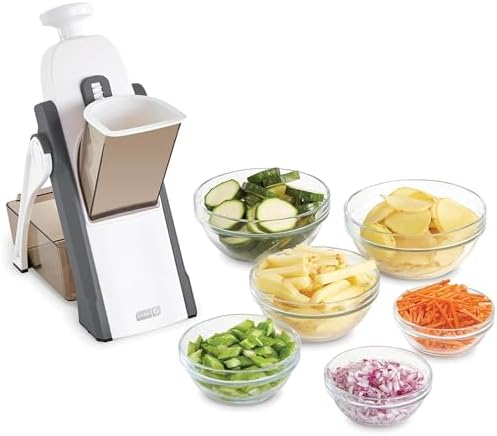
4. DASH Safe Slice Mandoline – Safest Option
If you’re genuinely worried about cutting yourself, the DASH Safe Slice is designed specifically for you. This one takes a completely different approach to safety.
Instead of sliding food horizontally across a blade, you place ingredients in a vertical chute and push down with a spring-loaded mechanism. Your hands never go anywhere near the blade, so it’s basically impossible to cut yourself unless you deliberately stick your finger into the chute. I’ve recommended this to several students who were terrified of traditional mandolines, and they’ve all loved it.
The thickness adjustment is simple with a dial on the back, and it can julienne, dice, and make french fries in addition to regular slicing. The cuts come out clean and even. However, the chute design does limit what you can slice. Large vegetables need to be cut down to fit, and cleaning the chute can be a bit fiddly.
Pros: Extremely safe design, hands never near blade, easy thickness adjustment, clean cuts
Cons: Chute limits vegetable sizes, harder to clean, takes up counter space
Best for: Safety-conscious cooks, parents with curious kids, anyone recovering from a mandoline injury
5. Swissmar Borner V-Slicer Plus – Best Premium Pick
The Swissmar Borner is what I’d call the Rolls Royce of mandolines. It combines the sturdiness of French-style mandolines with thoughtful German engineering.
This beauty comes with multiple interchangeable blades for thick slicing, thin slicing, shredding, and julienne cuts. The V-shaped blades grab food really effectively and produce consistently even results. According to Good Housekeeping’s testing, the V-blade design means less snagging and more even cuts compared to single-blade models.
It includes grippy feet to prevent sliding, an angled platform that makes slicing more comfortable, and a hand guard that actually works well. Everything stores together in a protective caddy. It’s a premium product with a premium price tag, but if you use a mandoline regularly, the quality is worth it.
Pros: High-quality construction, V-blade design, multiple blade options, storage caddy included
Cons: Expensive, takes up storage space, more parts to keep track of
Best for: Serious home cooks, anyone who uses a mandoline frequently
6. OXO Handheld Mandoline – Best Budget Option
Sometimes you just need something simple and affordable. The OXO Handheld Mandoline delivers exactly that.
This little gadget is about the size of a large spoon grater, and it’s perfect for quick jobs like slicing a cucumber for salad or shaving apples for a tart. It has three thickness settings (though they’re all on the thinner side), a built-in blade guard for safety when stored, and it’s completely dishwasher safe. The ceramic blade is sharp and doesn’t rust.
The limitations are obvious, you can’t slice large vegetables, there’s no julienne option, and the blade will eventually dull (and can’t be sharpened or replaced). But for a budget price, it’s a solid little tool that earns its place in the drawer. I keep one in my holiday rental property because it’s cheap enough that I won’t cry if someone nicks it, but functional enough to be genuinely useful.
Pros: Extremely affordable, compact storage, dishwasher safe, simple to use
Cons: Limited thickness options, blade dulls over time, can’t handle large vegetables
Best for: Budget-conscious cooks, small kitchens, occasional users

7. Fullstar Mandoline Slicer 6-in-1 – Best Value
The Fullstar 6-in-1 is like the Swiss Army knife of mandolines. It does a bit of everything, and whilst it’s not the absolute best at any single function, the overall package represents incredible value.
This set includes six different stainless steel blades for slicing, dicing, grating, shredding, and julienne cuts. It comes with both a hand guard AND cut-resistant gloves, which I appreciate whilst having options is good. The built-in container catches all your sliced vegetables, keeping your bench clean and making the whole process more efficient.
I particularly like this one for meal prep. On Sundays, I’ll use it to slice and dice a week’s worth of vegetables in about 20 minutes. The container stores everything neatly in the fridge until I need it. The non-slip base keeps it stable, and everything’s dishwasher safe.
The downside is that with so many parts, it can feel a bit overwhelming at first. And honestly, some of the blade attachments are better than others—the basic slicer is excellent, whilst the grater is just okay.
Pros: Great value, includes gloves and container, multiple functions, dishwasher safe
Cons: Many parts to manage, quality varies between blades
Best for: Meal preppers, large families, anyone wanting multiple functions in one tool
8. Microplane Adjustable V-Blade – Best Compact Design
I’ve been using a Microplane mandoline for years, and it’s still one of my favourites for everyday use. Microplane is famous for their graters, and they’ve brought that same attention to blade quality to this mandoline.
The V-shaped blade centers what you’re cutting and produces remarkably even slices. The dial adjustment is precise, and you can flip a plate over to do julienne cuts. It’s relatively compact compared to full-size mandolines, making it easier to store and pull out for quick jobs. According to a product test by Chris Loves Julia, the Microplane even managed to slice hard-boiled eggs with the yolk intact—that’s impressive precision.
Because it’s more open than enclosed mandolines, you need to be careful and use the hand guard (or gloves). But that openness also makes it easier to clean thoroughly. I’ve had mine for about four years and the blade is still incredibly sharp.
Pros: Precise V-blade, compact design, maintains sharpness well, easy to clean
Cons: Open design requires careful handling, hand guard could be better
Best for: Experienced users, anyone wanting a balance of quality and compact size
9. Prepworks by Progressive Adjust-a-Slice – Best All-Rounder
The Prepworks Adjust-a-Slice is a solid middle-ground option that does everything reasonably well without any major weaknesses.
This mandoline features multiple blade styles including straight, julienne, and wavy cuts. The thickness adjustment is clearly marked with preset options, so there’s no guesswork involved. The hand guard has good grippy prongs that actually hold onto food securely, and the whole unit has a stable, non-wobble design.
What makes this an all-rounder is that it’s genuinely good at everything. It’s not the cheapest, sharpest, most compact, or most versatile, but it’s good enough in all those categories that most users will be completely satisfied. According to Reviewed’s testing, this was their top pick alongside the DASH because it balanced performance, safety, and ease of use so well.
Pros: Well-balanced features, good hand guard, clear settings, stable design
Cons: Not exceptional in any single category, mid-range price
Best for: Anyone wanting a reliable all-purpose mandoline without overthinking the decision
10 Kyocera Ceramic Mandoline – Best for Small Kitchens
Finally, the Kyocera Ceramic Mandoline is perfect if you’ve got limited kitchen space and don’t need fancy features.
This handheld slicer has a ceramic blade that stays sharper longer than steel and will never rust. It’s tiny enough to fit in a drawer with your other hand tools, and it’s lightweight enough that my mum, who has arthritis, finds it easy to use. The four thickness settings cover the basics, and the simple design means there’s nothing complicated to figure out.
The limitations are real though, it can only make basic slices (no julienne), and it’s too small for large vegetables like eggplants. But if all you want is to slice cucumbers for salad or radishes for tacos, it does that job brilliantly. America’s Test Kitchen named it their favourite compact mandoline for good reason.
Pros: Extremely compact, ceramic blade stays sharp, lightweight, simple to use
Cons: Very limited functionality, can’t handle large vegetables
Best for: Small kitchens, simple slicing needs, anyone wanting minimal storage footprint
What’s the Difference Between French and Japanese Mandolines?
I get asked this question constantly, so let’s break it down properly.
French-style mandolines are typically larger and sturdier. They usually have a platform that props up at an angle with fold-out legs, and they often feature V-shaped blades. These models are built like tanks and are heavy, stable, and designed to handle large volumes of food. They usually come with multiple interchangeable blades for different cutting styles. The OXO V-Blade and Swissmar Borner are classic examples of French-style design.
Japanese mandolines, on the other hand, are simpler and more compact. They typically have a single straight blade and a slimmer profile that makes them easier to store. The Benriner is the classic example. Japanese mandolines are lighter, often sharper, and more affordable, but they usually have fewer features and simpler hand guards.
Which is better? Honestly, it depends on what you need. If you’ve got the storage space and want maximum versatility, a French mandoline is brilliant. If you’ve got limited space and prioritise sharpness and simplicity, go Japanese.
In my kitchen, I actually keep both. I use my Benriner for quick everyday jobs like slicing cucumbers or onions, and I pull out the bigger French-style mandoline when I’m doing large batch cooking or need specialty cuts. But if I could only have one, I’d probably go with a good French-style model for its versatility.
The other consideration is price. Japanese mandolines tend to be more affordable because they’re simpler designs with fewer parts. French models with all their bells and whistles usually cost more.
Do I Need Cut-Resistant Gloves for a Mandoline?
Short answer: yes, you should absolutely have them.
Look, hand guards are great when they work well, but not all of them are created equal. Some are clunky, some don’t grip food properly, and some just feel awkward to use. Cut-resistant gloves give you flexibility (literally) whilst still protecting your fingers.
I recommend having both a hand guard AND gloves in your arsenal. Use the hand guard whenever possible, but keep gloves on hand (pun intended) for situations where the guard is impractical. For instance, when you’re slicing something small and irregularly shaped, gloves give you better control than a hand guard.
The NoCry cut-resistant gloves are my top recommendation. They’re made with high-performance polyethylene fibres that are four times stronger than leather, yet they’re thin enough that you maintain good dexterity. They come in multiple sizes, so you can get a proper fit, and they’re machine washable.
Other good options include the Dowellife Cut Resistant Gloves and the gloves that come with some mandoline sets like the Fullstar. Just make sure whatever you get is actually rated for cut resistance—not all kitchen gloves are.
One important note: cut-resistant gloves are not cut-proof. They’ll protect you from accidental contact with the blade, but if you deliberately press your gloved finger into a razor-sharp mandoline blade, you’ll still get cut. They’re a safety aid, not a suit of armour.
Some professional chefs actually prefer using multiple gloves layered together. According to safety tips from culinary professionals, wearing three gloves and using the centre of your palm to guide food is a common technique in busy kitchens.
What Foods Can You Cut with a Mandoline?
Mandolines are incredibly versatile! Let me walk you through some of my favourite uses and a few things to avoid.
Brilliant for mandolines:
- Root vegetables (potatoes, sweet potatoes, carrots, beetroot, turnips)
- Firm vegetables (cucumbers, courgettes, eggplant, cabbage)
- Hard fruits (apples, pears, firm peaches)
- Onions and fennel (for those gorgeous thin slices)
- Hard cheeses (like cheddar or parmesan)
- Firm salamis and cured meats
I use mine constantly for making potato chips, scalloped potatoes, and vegetable gratins where uniform thickness is crucial. It’s also brilliant for coleslaw, where you want really thin cabbage shreds. And don’t even get me started on how perfect it is for cucumber salads and you can get them so thin they’re almost translucent.
For something really impressive, try making vegetable carpaccio. Thinly slice beetroot, radishes, or fennel, arrange them artfully on a plate, drizzle with good olive oil and lemon juice, and suddenly you’ve got restaurant-quality presentation with minimal effort.
Foods to avoid or be careful with:
- Very soft or mushy vegetables (overripe tomatoes, soft courgettes)
- Foods with pits or hard seeds
- Anything too small to safely hold
- Leafy greens (they’ll just get mangled)
- Soft cheeses (they’ll stick to the blade)
Soft tomatoes can be tricky. If they’re firm and ripe, they slice beautifully. If they’re too soft, they turn into mush. The V-blade designs handle soft foods better than straight blades.
According to Tasting Table’s guide to mandoline uses, one brilliant application is making vegetable chips. Slice beetroot, parsnips, sweet potatoes, or even kale stems paper-thin, toss with a bit of oil and seasoning, then bake until crispy. It’s so much better than shop-bought chips.
You can also use a mandoline for making zucchini noodles (zoodles) if it has a julienne blade. Not as good as a dedicated spiralizer, but it works in a pinch.
One creative use I discovered by accident: slicing firm tofu for marinating. Uniform slices mean even absorption of marinade flavour. Works brilliantly.
How Do You Clean a Mandoline Slicer?
Cleaning a mandoline requires care and attention as this is where a lot of injuries actually happen, believe it or not.
First rule: never, ever just chuck your mandoline in the sink with soapy water. Someone (probably you, later) will reach in without looking and grab onto the blade. Instead, clean it immediately after use whilst you’re still being mindful of where the blade is.
Step-by-step cleaning guide:
- Disassemble safely. Remove any detachable blades or guards. Do this slowly and deliberately, keeping your fingers away from sharp edges.
- Rinse immediately. Run it under water to remove food particles whilst they’re still fresh. Dried-on bits are much harder to remove later.
- Use a brush, not your hands. Get a bottle brush or vegetable brush with a long handle. This keeps your fingers away from the blade whilst you scrub. Work the brush along the blade’s length, not across it.
- Pay attention to crevices. Food particles love to hide in corners and joints. A small brush or old toothbrush works well for these spots.
- Dry thoroughly. Water spots can lead to rust on metal blades. Pat dry with a tea towel or let air dry on a dish rack where the blade is visible and safe.
- Store safely. Either keep the blade guard on or store it somewhere where you won’t accidentally grab it. Many mandolines come with storage cases so use them!
Dishwasher or hand wash? This varies by model. Many mandoline bodies are dishwasher safe, but blades often aren’t. Check your specific model’s instructions. Even if the blades are technically dishwasher safe, I prefer hand washing because dishwasher detergent can dull blades over time.
For stubborn stuck-on food, soak the mandoline in warm soapy water for a few minutes first. Never scrub aggressively with abrasive pads – they’ll scratch the surface and dull the blade.
If your mandoline has a ceramic blade (like the Kyocera), you can be a bit less worried about rust, but you still need to be careful whilst cleaning because ceramic blades can chip if handled roughly.
Slicing It All Together (See What I Did There?)
After years of teaching culinary skills and using mandolines almost daily, I can confidently say they’re one of the most useful kitchen tools you can own and if you treat them with proper respect.
The key takeaway here is that safety and functionality go hand in hand. Don’t sacrifice your fingertips trying to save a few dollars on a cheap, poorly designed mandoline. Invest in a quality model with good safety features, always use the hand guard or cut-resistant gloves, and take your time whilst working.
Whether you choose the versatile Mueller, the beginner-friendly OXO, the precision-focused Benriner, or any of the other excellent options on this list, you’ll be able to create professional-looking dishes with a fraction of the effort. Those gorgeous potato gratins, paper-thin radish salads, and perfectly uniform vegetable chips are all within reach.
Remember: your mandoline should make cooking more enjoyable, not more stressful. If you’re feeling nervous, start with the DASH Safe Slice or another highly protective model. Build your confidence with easier vegetables before tackling tougher ones. And please, for the love of all things culinary, use that hand guard.
Now I’d love to hear from you! What’s your experience with mandolines? Do you have a favourite model or a horror story that’ll make the rest of us wince? Drop a comment below and share your tips, tricks, or questions. And if you found this guide helpful, share it with a friend who’s been thinking about getting a mandoline—help me save some fingertips out there!
Happy (and safe) slicing!
About the Author
My Kitchen Sage Team — We are a team of passionate home cooks who have tested and reviewed over 200 kitchen appliances for this site. Our recommendations are based on hands-on testing in real home kitchens, not manufacturer spec sheets. Learn how we test


